
Irish Roots. Leadership Journeys.
AT A GLANCE: Around St Patrick’s Day, Ireland’s storytelling tradition often reflects on leaders navigating uncertainty — balancing courage, loyalty, judgment and responsibility when the path ahead is not fully clear. Across more than twenty years of executive search, leadership development and governance advisory work, a recurring pattern emerges. Leadership success is rarely determined by talent alone. It depends on coherence between the leader, the system and the context they enter. This article introduces the Deabadh perspective on leadership systems — highlighting five observations about how leadership actually works inside organizations, and why most leadership challenges are not leadership problems at all, but problems of leadership architecture.
Leadership Coherence in a Complex World
Around St Patrick’s Day, Ireland’s storytelling tradition often surfaces stories of leaders navigating uncertainty — balancing courage, loyalty, judgment and responsibility when the path ahead is not fully clear.
Across more than twenty years of executive search, leadership development and governance advisory work, one pattern repeatedly emerges:
Leadership success is rarely determined by talent alone - it emerges from coherence between the leader, the system and the context.
This observation sits at the heart of the Deabadh Perceptual Framework.

What the Data Shows
Our work over the past two decades — reflected in The Data: 20 Years of Leadership Coherence — highlights a recurring pattern.
Organizations rarely struggle because they lack capable leaders.
More often, leadership capability and system context are misaligned.
In high-performing environments, several elements tend to move together:
Leadership judgment
Governance clarity
Cultural expectations
Decision rhythms
Strategic purpose
When these elements align, organizations gain momentum.
When they diverge, friction increases — regardless of the leader’s individual capability.
A Core Insight
Most leadership problems are not leadership problems. They are leadership architecture problems — emerging when leadership capability, governance systems and organizational context fall out of alignment.
Five Observations About Leadership Systems
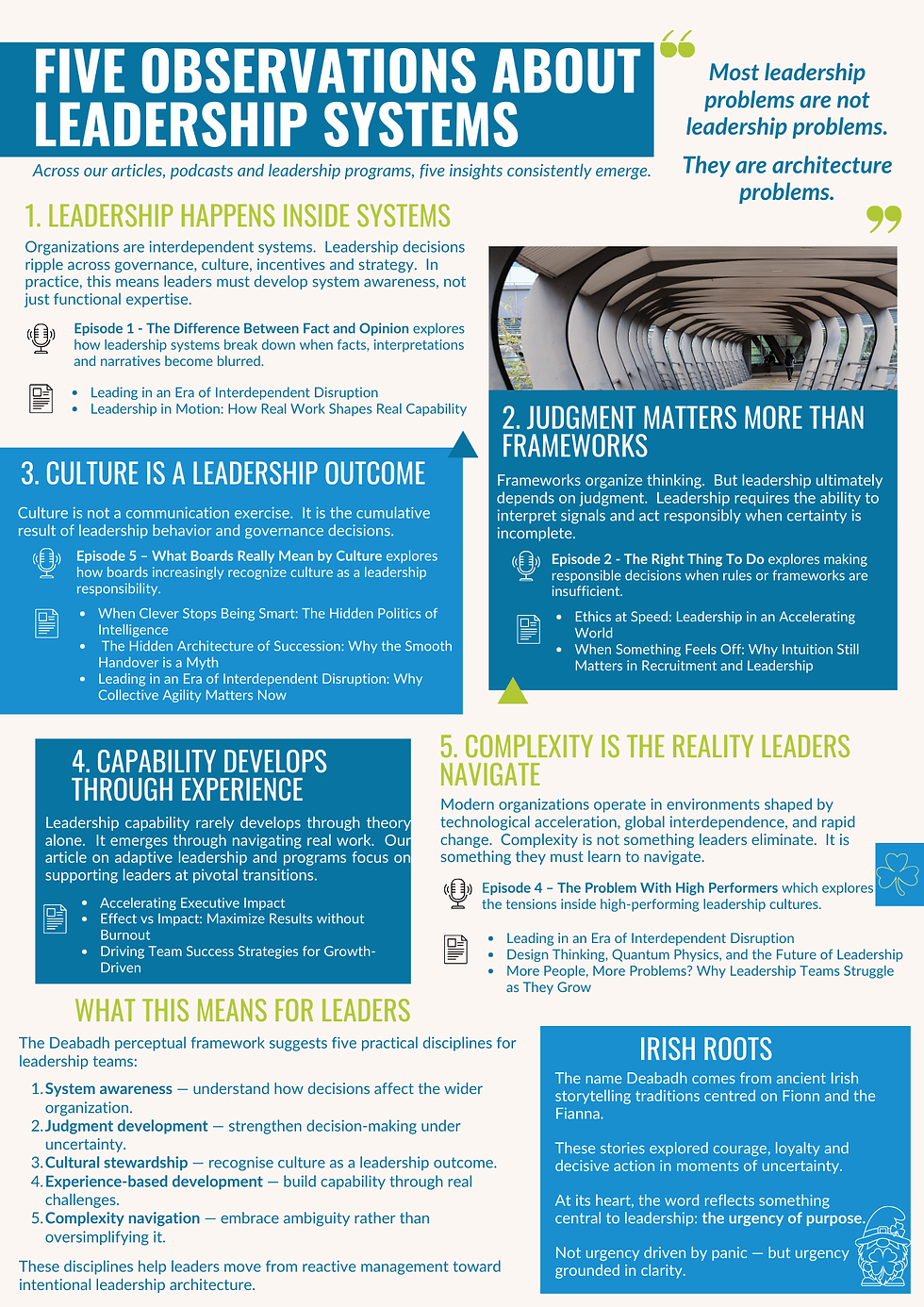
Across our articles, podcasts and leadership programs, five insights consistently emerge.
1. Leadership Happens Inside Systems
Organizations are interdependent systems. Leadership decisions ripple across governance, culture, incentives and strategy.
The most effective leaders develop system awareness, not just functional expertise.
2. Judgment Matters More Than Frameworks
Frameworks help organize thinking.
But leadership ultimately depends on judgment — the ability to interpret signals and act responsibly when certainty is incomplete.
3. Culture Is a Leadership Outcome
Culture is not a communication exercise.
It is the cumulative result of leadership behavior and governance decisions.
4. Capability Develops Through Experience
Leadership capability rarely develops through theory alone.
It emerges through navigating real work and real challenges.
5. Complexity Is the Reality Leaders Navigate
Modern organizations operate in environments shaped by technological acceleration, global interdependence and rapid change.
Complexity is not something leaders eliminate.
It is something they learn to navigate.
What This Means for Leaders
The Deabadh perceptual framework suggests five practical disciplines for leadership teams:
System awareness
Judgment development
Cultural stewardship
Experience-based leadership development
Complexity navigation
These disciplines help leaders move from reactive management toward intentional leadership architecture.
Irish Roots

The name Deabadh comes from ancient Irish storytelling traditions centred on Fionn and the Fianna.
These stories explored courage, loyalty and decisive action in moments of uncertainty.
At its heart, the word reflects something central to leadership:
the urgency of purpose.
Not urgency driven by panic — but urgency grounded in clarity.
Conclusion
Across the stories we inherit and the organizations we lead today, the challenge remains similar. Leadership is rarely about certainty. It is about judgment, coherence and clarity of purpose in moments when the path forward is not fully visible.
The task of leadership is not to eliminate complexity, but to navigate it with discipline and perspective.
Leadership journeys rarely unfold in straight lines. But with clarity of purpose and thoughtful judgment, leaders can move forward with confidence.
About Deabadh
Deabadh is a leadership advisory firm focused on executive search, leadership systems and governance effectiveness. Drawing on more than two decades of work with Boards and leadership teams, the Deabadh perceptual framework explores how leadership capability, organizational systems and context combine to shape performance.
Learn more at DeabadhGroup.com


Comments