
“Overqualified” Is What Happens When We Mistake Careers for Snakes and Ladders
AT A GLANCE: The idea of being “overqualified” often reflects outdated assumptions about how careers should progress. As careers become longer, more flexible and increasingly nonlinear, organizations risk overlooking valuable talent by confusing capability with ambition for promotion.
The Problem isn't the Candidate. It's the Model
For much of the last century, careers followed a relatively predictable pattern.
Learn.
Progress.
Lead.
Retire.

The metaphor was a ladder. Success meant climbing it.
The higher you climbed, the more authority, responsibility, status and reward you accumulated.
Many of our organizational systems were built around this assumption. Job grading structures, promotion pathways, succession planning and even recruitment processes often assume that career progression should move in a single direction: upward.
Yet the reality of work is changing.
People are living longer.
Retirement is increasingly flexible.
Portfolio careers are becoming common.
Experienced professionals are combining executive roles, consulting assignments, coaching, board positions, project work and entrepreneurial ventures in ways that would have been unusual a generation ago.
The result is a growing disconnect between how careers actually evolve and how organizations continue to think about talent.
The Problem with “Overqualified”
The phrase “overqualified” often reveals more about the system than the candidate.
What employers frequently mean is:
We are concerned this person will leave.
We worry they will become bored.
We assume they want something bigger.
We believe they will be dissatisfied.
We think they should be aiming higher.
Some of these concerns may be legitimate.
Many are assumptions.

Increasingly, experienced professionals are making deliberate choices that do not fit traditional career models.
Some are stepping away from large leadership positions.
Some are reducing travel.
Some are seeking flexibility.
Some are balancing work with family, health, creative pursuits or community responsibilities.
Others simply want to focus on the aspects of work they enjoy most.
None of this makes them overqualified.
It simply means their definition of success has evolved.
From Hierarchy to Contribution
Organizations facing skills shortages often find themselves in a curious position.
On one hand, they report difficulty finding experienced talent.
On the other, they reject capable candidates because their previous roles appear too senior.
The underlying assumption is that capability and job level must always move together.
But what if that assumption no longer holds?
The future may require a different question.
“What capability do we need? How should we deploy it?”
A former global executive may bring immense value to a regional role.
An experienced leader may prefer a specialist position.
A retired CEO may wish to mentor rather than manage.
A board member may choose project work over permanent employment.
The challenge is not capability.
The challenge is alignment.
Rethinking the Career Ladder

Perhaps the ladder is in itself becoming a less useful metaphor.
Modern careers often look less like a straight climb and more like a network of experiences, transitions, reinventions and choices.
People move sideways.
They pause.
They return.
They reinvent.
They combine multiple roles.
They deliberately trade status for flexibility, responsibility for balance or promotion for purpose.
Viewed through this lens, career decisions become less about climbing and more about contribution.
The Leadership Challenge
Leaders and organizations face an important question.
Are talent systems designed for the workforce we have today? Or for the workforce we had thirty years ago?
As working lives lengthen and career paths diversify, organizations that continue to view talent solely through the lens of hierarchy may find themselves overlooking valuable capability.
Those that learn to deploy capability more flexibly may gain access to talent, experience and wisdom that others continue to label as “overqualified.”
Perhaps the issue was never the candidate.....
Perhaps the issue was the game itself.
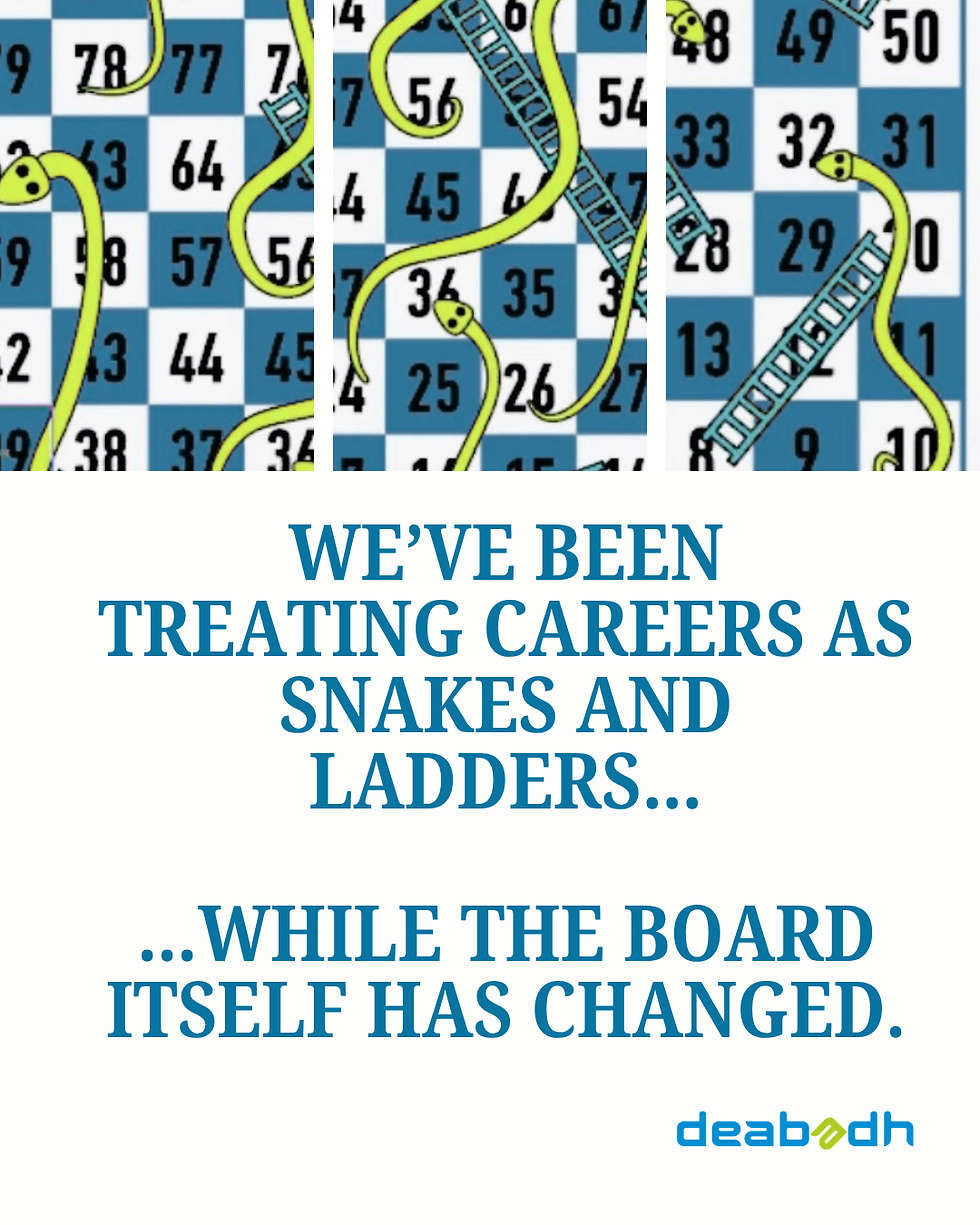
We have been treating careers as Snakes and Ladders when the board itself has changed.....


Comments